


RFID Key Fobs
Find the ideal passive RFID key fob for your industrial application. Specifically engineered for integration into OEM systems across the biomedical, automotive, and automation sectors, our transponders provide reliable, battery-free identification. By matching the frequency and physical housing to your specific environment, we help you build a robust hardware architecture that prevents integration delays and accelerates your path to market. If your project requires a different form factor, explore our range of industrial RFID tags.
-
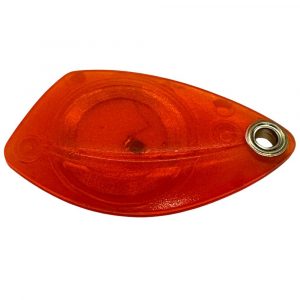
Plastic RFID Keyfob Tag
£0.75Read moreThis plastic RFID Keyfob Tag is available with LF transponder EM4102. Manufactured using ABS plastic, they are durable and perfect for a wide variety of LF RFID applications.
These LF (125kHz) keyfobs are tuned tightly to deliver the best performance with our LF Readers.
These keyfobs are available in a variety of colours and can be customised – please contact sales@eccel.co.uk for more information or a bespoke quote.
-
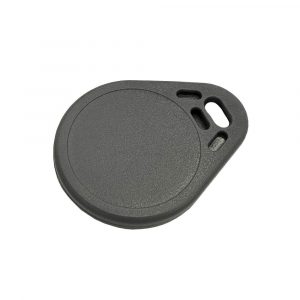
Plastic RFID NFC Keyfob Tag
£0.95Read moreThese RFID NFC Keyfobs / Tags are available with a variety of transponders, such as, but not limited to, ICODE SLIX, MIFARE Classic 1K and NTAG213. Manufactured using ABS plastic, they are durable and perfect for a wide variety of NFC / HF RFID applications.
These HF (13.56MHz) keyfobs are tuned tightly to deliver the best performance with our HF Readers:
https://eccel.co.uk/product-category/rfid-readers-modules/current/current-hf-13-56-mhz/
These keyfobs are available in a variety of designs and can be customised – please contact sales@eccel.co.uk for more information or a bespoke quote.
-
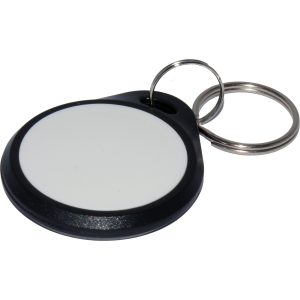
Two Colour Small Keyfob UHF ALIEN Higgs 3 EPC (Black & White)
£1.10Add to basketA 2-colour (standard stock is black body with white insert face) -UHF-ISO-18000-6C-ALIEN Higgs-3-EPC-GEN2 , 868MHz based IP65 rated Keyfob. Dimensions are 34mm x 30mm x 5.1mm. Custom printing of the face is available upon request (minimum order quantity for custom printing/programming is 100 pieces), as is serial number printing on the face and/or custom programming of the transponder memory. Please contact us for details on these non standard requirements of product colours and custom printing and/or programming. Lead time is 2-3 weeks to order
-
Two Colour Small Keyfob EM4102 (Black & White)
£1.10Add to basketA 2-colour (standard stock is black body with white insert face) EM4102, 125KHz based IP65 rated Keyfob. Dimensions are 34mm x 30mm x 5.1mm. Custom printing of the face is available upon request, as is serial number printing on the face. Please contact us for details on these non standard requirements of product colours and custom printing. Lead time is 2-3 weeks to order.
Selecting an RFID Key Fob for OEM Embedded Systems
When evaluating RFID key fobs, the first step is identifying the correct frequency range for your environment. Low Frequency (LF) transponders operate between 125 and 134.2 kHz and are highly resistant to interference from liquids and metal at short ranges. High Frequency (HF) devices, operating at 13.56 MHz, offer a balance of security and memory, making them the standard for NFC cards and secure access tokens. Ultra-High Frequency (UHF) tags provide high-speed data transfer at distances up to 12 meters, ideal for large-scale automotive manufacturing and logistics.
Selecting the right baseline device ensures that your hardware functions reliably within its intended setting. By evaluating physical constraints early in the design phase, OEMs can minimize the need for costly workarounds later in the project. This targeted selection reduces R&D expenses and secures the long-term technical stability of the host system.
Rugged RFID Fobs for Harsh Environments
Standard fobs often experience signal failure in metal-heavy or harsh industrial settings. When a device fails to read due to signal disruption from nearby surfaces, the solution lies in specialized physical engineering. Customizing the housing and the internal tuning ensures industrial versatility, allowing engineers to bypass complex system redesigns and protect project margins.
Antenna Tuning and Protective Materials
Metallic surfaces can disrupt the electromagnetic field of a transponder, reducing its range. We resolve this by realigning the resonant frequency of the antenna to match its specific operating environment. This engineering process involves using dielectric spacers that act as a physical buffer between the antenna and the conductive surface, ensuring consistent performance. Our range of RFID antennas can further optimize this setup.
For demanding conditions, we utilize high-performance engineering plastics like PPS, PEEK, and ABS to construct enclosures that withstand chemicals, vibration, and moisture. For high-temperature or medical sterilization environments, fobs can be encapsulated in ceramics or durable epoxy resins. These modifications protect the internal chip and ensure the card or fob remains operational for 10+ years, safeguarding your ROI.
Supply Chain Stability and Manufacturing Quality
The reliability of an RFID key fob depends on strict manufacturing tolerances. Minor variations in antenna dimensions can lead to inconsistent signal strength across a batch. At our automated manufacturing facility in Poland, we enforce tight quality controls to ensure every transponder performs identically. This consistency reduces failure rates on the production line and provides a predictable engineering workflow for high-volume deployments.
Accelerating Project ROI with Dedicated Support
Partnering with Eccel for bespoke engineering directly impacts the financial success of your OEM project. By utilizing our in-house manufacturing and technical support, you can mitigate the risks of component obsolescence and standard product failure. We ensure your chosen transponder meets all environmental requirements from day one.
- Minimize engineering costs: Work with specialists to select environment-specific transponders.
- Reduce R&D cycles: Eliminate trial-and-error testing with incompatible off-the-shelf fobs.
- Faster breakeven: Transition rapidly from prototype to automated mass production in Europe.
- Secure supply chain: Custom designs protect your production line against sudden component shortages.
- Seamless integration: Ensure your key fobs work perfectly with our NFC tag readers and reader modules.
Integration Steps for Industrial RFID Systems
Integrating a passive transponder into a host system requires a structured roadmap to ensure communication stability and regulatory compliance. This streamlined approach secures your project timeline from initial evaluation to final deployment.
- Requirement Analysis: Selecting the appropriate LF, HF, or UHF device based on physical constraints and data needs.
- Prototyping: Performing antenna tuning and selecting rugged packaging to resolve localized interference.
- Regulatory Certification: Validating the system against international standards. Pairing fobs with readers that carry Full Modular Approval (FCC/CE) allows many OEMs to bypass complex RF testing.
- Lifecycle Support: Scaling up to mass production with continuous support to maintain manufacturing tolerances.
Secure Protocols and Data Protection
To ensure secure data exchange, our RFID key fobs support air interface standards such as ISO/IEC 14443 and 15693. For high-security applications, we utilize AES-128 encryption to prevent cloning and unauthorized access. On the host side, we support interfaces like RS485 and I2C, which prevent data collisions and ensure reliable communication between the transponder and the main controller.
