

RFID Technology in Supply Chain Management
Modern supply chains span continents, involve hundreds of suppliers, and move millions of items through production, warehousing, distribution, and retail – all under pressure to be faster, leaner, and more transparent than ever before.
RFID provides the end-to-end visibility that makes this possible. By tagging products, pallets, containers, and assets with RFID, every movement through the supply chain is captured automatically – and can be integrated to feed real-time data into your WMS, ERP and TMS platforms without manual scanning. Eccel designs and manufactures the embedded RFID tags and reader modules that power these systems.
RFID Across the Supply Chain
RFID provides unbroken visibility from the moment goods are produced to the point they reach the end customer across every stage and every handover.
Tags applied at manufacture. Parts and sub-assemblies tracked through production stages.
- Goods receiving
- WIP tracking
- Shipping verification
>
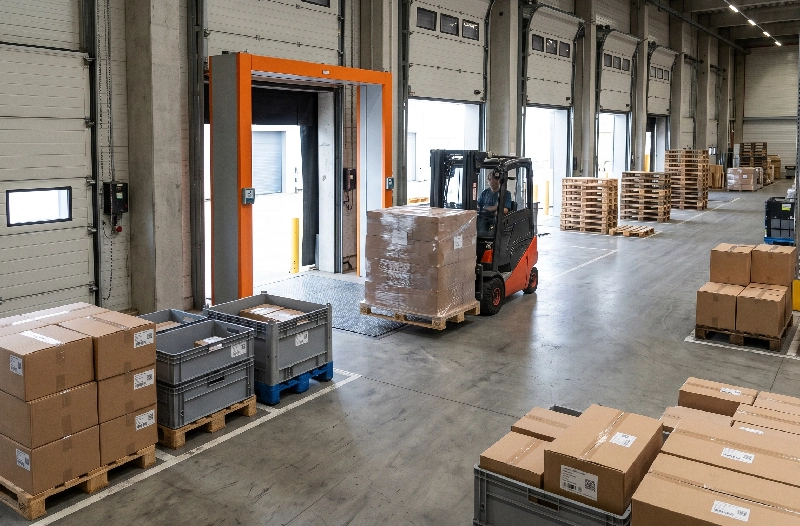
RFID portals at dock doors automate receiving. Fixed readers track pallet and container movement
- Automated goods-in
- RTI tracking
- Inventory accuracy
>
Shipments verified at loading. Real-time route and container tracking throughout transit.
- Loading verification
- In-transit visibility
- Proof of delivery
>
Goods verified on arrival. Item-level RFID enables inventory management and omnichannel fulfilment.
- Stock accuracy
- Picking validation
- Authentication
The Supply Chain Visibility Challenge
Global supply chains are more complex and more exposed than ever. Traditional tracking methods cannot provide the speed, accuracy, and granularity that modern operations demand.
+
Goods disappear between handover points. Without continuous tracking from supplier to end customer, blind spots in the supply chain lead to lost items, delayed responses, and costly investigations.
+
Barcode scanning requires line-of-sight, one item at a time. At high-throughput receiving docks and sorting facilities, manual scanning creates bottlenecks, errors, and missed reads that corrupt inventory records.
+
Returnable transport items (pallets, crates, dollies, and specialist containers) go missing across supplier and customer sites, generating replacement costs and disrupting production schedules.
+
Regulatory requirements in food, pharma, and other sectors demand full chain-of-custody records. Manual documentation is incomplete, error-prone, and costly to maintain, particularly when recalls or audits occur.
RFID Applications in Supply Chain
From the supplier’s loading dock to the end customer, RFID integrates into every stage of the supply chain to automate tracking, verify shipments, and maintain complete traceability.
WAREHOUSE RECEIVING & GOODS-IN
RFID portals at dock doors read incoming shipments automatically with no manual scanning. Items are logged, verified against purchase orders, and directed to the correct storage location in seconds, with no human intervention required.
INVENTORY MANAGEMENT & STOCK ACCURACY
Replace manual cycle counts with automated RFID reads across entire warehouse zones. Achieve near-perfect inventory accuracy, eliminate ghost stock and phantom inventory, and trigger automatic replenishment when stock falls below threshold.
PALLET & CONTAINER TRACKING
Tag pallets, crates, and containers and track them automatically through goods-in, racking, and dispatch. Know where every logistics unit is, what it contains, and when it last moved — across your own sites and at supplier and customer facilities.
OUTBOUND SHIPMENT VERIFICATION
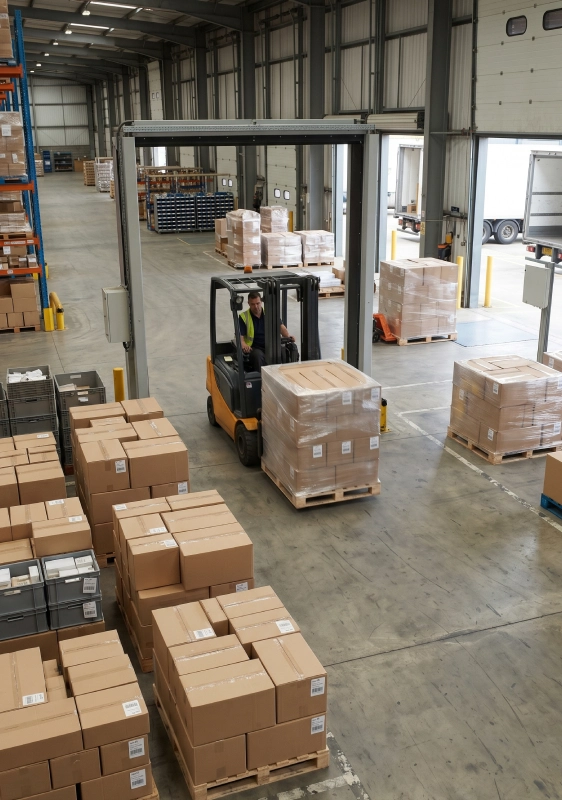
RFID gates at dispatch doors verify outbound shipments automatically as pallets and vehicles pass through. Catch mispicks, short shipments, and wrong-destination errors before goods leave the building – reducing returns and customer disputes.
COLD CHAIN & CONDITION MONITORING
Some specialist RFID tags can monitor temperature and humidity throughout the cold chain from production through storage and transport to the point of delivery. Automated logging provides regulatory-compliant records for food, pharmaceutical, and chemical supply chains.
RETURNABLE TRANSPORT ITEM MANAGEMENT
Track returnable pallets, dollies, racks, and specialist containers across your entire supplier and customer network. Reduce RTI losses, minimise pool replacement costs, and ensure the right containers are available for the next production or delivery cycle.
PRODUCT AUTHENTICATION & BRAND PROTECTION
Embed RFID or NFC tags in products at manufacture to create a verifiable digital identity for every item. Enable authentication at any point in the supply chain, or directly by customers using a smartphone, to detect counterfeits and protect brand integrity.
END-TO-END TRACEABILITY & COMPLIANCE
Build a complete chain-of-custody record for every product from raw material to end customer. RFID-generated traceability data supports product recalls, regulatory audits, sustainability reporting, and compliance with EU Digital Product Passport requirements.
CROSS-DOCKING & SORTATION
RFID enables high-speed automated sortation in cross-docking facilities. Items are identified as they arrive and directed to the correct outbound lane without manual scanning, accelerating throughput and reducing handling errors at distribution hubs.
Example: How RFID Works in Supply Chain Operations
RFID turns every handover point into an automatic data capture event, connecting your entire supply chain into a single, real-time data stream.
1
RFID tags are applied to products, pallets, or containers at the point of manufacture or at goods-in. Each tag carries a unique identifier linked to item data in your ERP or WMS establishing the digital identity that follows the goods through every subsequent step.
2
Fixed RFID readers at dock doors, conveyor transitions, and storage areas capture tag data automatically as goods move through. No manual scanning, no line-of-sight, no delays – entire pallets or containers are read in seconds.
3
Every read event updates your WMS, ERP, or TMS in real time. Inventory positions, shipment status, and asset locations are always current, providing live dashboards for warehouse managers, planners, and logistics teams.
4
As loads are assembled and vehicles depart, RFID gates verify the contents automatically. Errors are flagged before the vehicle leaves the site – preventing mis-shipments, short deliveries, and wrong-destination loads.
5
Every read event is timestamped and stored, building a complete chain-of-custody record for every item. This supports traceability audits, regulatory compliance, product recalls, and sustainability reporting across the entire supply chain.
Benefits of RFID in Supply Chain Management
Supply chain operations using RFID report measurable gains across accuracy, throughput, asset utilisation, and compliance.
✔
Track every item, pallet, and container from supplier to end customer in real time. Eliminate blind spots between handover points and react instantly to exceptions, delays, and discrepancies.
✔
Automated outbound verification catches mispicks and short shipments before vehicles depart. Reduce returns, customer complaints, and the cost of correcting fulfilment errors after the fact.
✔
Automated RFID reads deliver inventory accuracy rates of 98–99%, compared to 60–80% with manual barcode processes. Accurate data means fewer stockouts, less safety stock, and better demand planning.
✔
Every movement is logged automatically, creating audit-ready chain-of-custody records. Support product recalls, regulatory audits, and emerging requirements such as the EU Digital Product Passport.
✔
RFID reads entire pallets and shipments in seconds. Receiving, putaway, picking, and dispatch operations are faster and less labour-intensive increasing throughput without adding headcount.
✔
Automating scanning, counting, and verification tasks reduces manual labour requirements by 20–50% in targeted areas. Staff are freed for higher-value activities rather than repetitive data entry and stock checks.
✔
Real-time tracking of returnable transport items across supplier and customer sites dramatically reduces asset losses. Optimise pool sizes and ensure containers are available when and where production needs them.
✔
RFID data can be integrated into SAP, Oracle, Microsoft Dynamics, and most WMS and TMS platforms – providing live supply chain dashboards, automated demand signals, and real-time exception management.
Why Choose Eccel for Supply Chain RFID
We design and manufacture the tags and readers that sit inside supply chain RFID systems – engineered for the demands of logistics and distribution environments.
Logistics-Grade Tags
Tags for on-pallet, on-metal, and on-container mounting. UHF inlays for long-range portal reads, HF/NFC for item-level authentication, and rugged enclosures for reusable RTI assets.
PL Manufacturing
In-house production with strict RF tolerances. Short lead times, full traceability, and direct access to our engineering team. ISO 9001 certified.
LF / HF / UHF Range
Full frequency coverage: UHF for long-range pallet and container tracking, HF/NFC for item-level and authentication applications, LF for harsh metal-proximity environments.
OEM-Ready Modules
Pre-certified reader modules (FCC, CE) with RS485, SPI, I2C, USB, Wi-Fi, Ethernet, and WPAN interfaces. Designed to embed directly into dock-door portals, conveyor systems, and handheld devices.
Need RFID tags or readers for supply chain tracking?
Contact our team for a free consultation. We’ll recommend the right components for your environment, frequency, and integration requirements.

