

RFID Solutions for Medical Laboratory & Life Sciences Equipment
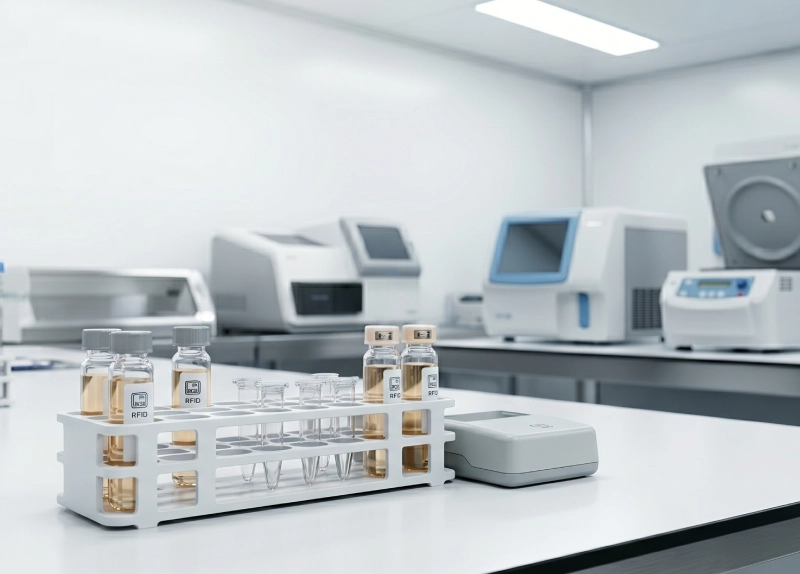
Clinical and research laboratories handle thousands of samples, reagents, and instruments every day, often under strict regulatory scrutiny and in environments that destroy ordinary labels. A single misplaced specimen can delay a diagnosis or, in the case of a biopsy, mean there is no second chance to take the sample. RFID gives every item a unique digital identity that can be read without line of sight, so laboratories gain accurate, real-time visibility of where each sample, reagent, and asset is at any moment.
Eccel Technology designs and manufactures embedded RFID tags, labels, and reader modules in our own facilities. We supply laboratories, diagnostics providers, and life sciences equipment manufacturers with tags built to survive autoclave cycles, chemical exposure, and sub-zero storage, alongside reader modules that integrate cleanly with LIMS, ERP, and quality systems.
The Challenge in the Laboratory
Laboratories run on traceability, yet most still rely on printed barcodes and manual logs that struggle in real lab conditions. These are the recurring problems RFID is designed to solve.
+
Pre-examination handling is the leading source of laboratory errors. A mislabelled or missing specimen can compromise a result, and some samples, such as biopsies, cannot be retaken.
+
Barcodes need close, one-by-one line-of-sight scanning. Highly qualified staff spend a large share of their time on manual registration and admin instead of core scientific work.
+
Autoclave heat and pressure, aggressive cleaning chemicals, and cryogenic freezing degrade standard adhesive labels and the data printed on them.
+
Accreditation and regulatory standards demand a documented, auditable trail for every sample. Reconstructing that trail from handwritten logs is slow and error-prone.
RFID Use Cases in Laboratory & Life Sciences
From the moment a sample is collected to the point it is disposed of, RFID supports every stage of the laboratory workflow and the equipment that runs it.
SAMPLE & SPECIMEN TRACKING
Give every blood, tissue, or biopsy sample a unique digital identity and maintain an unbroken chain of custody from collection through to disposal.
REAGENT & CONSUMABLE INVENTORY
Track stock levels, lot numbers, and expiry dates automatically, so reagents are reordered on time and waste from expired stock is reduced.
COLD CHAIN & TEMPERATURE MONITORING
Monitor freezers, cryo storage, and sub-zero samples, with automatic alerts the moment conditions move outside the required range.
LABORATORY EQUIPMENT & ASSET TRACKING
Locate analysers, microscopes, pipettes, and portable instruments instantly, reducing time lost searching and supporting maintenance schedules.
STERILISATION & AUTOCLAVE TRACKING
Use autoclave-tolerant tags to record each instrument and tray through sterilisation cycles, giving full visibility of the cleansing process.
LIMS INTEGRATION & DATA CAPTURE
Update your Laboratory Information Management System automatically as samples pass each reader, removing manual entry and the errors that come with it.
REGULATORY COMPLIANCE & ACCREDITATION
Generate a complete, time-stamped audit trail for every sample, making it far easier to evidence compliance during inspection and accreditation.
LIFE SCIENCES EQUIPMENT MANUFACTURING
Embed RFID into devices and equipment to support FDA UDI compliance, onboard lifecycle tracking, and automatic component identification.
ANTI-COUNTERFEITING & AUTHENTICATION
Authenticate reagents, consumables, and devices so only genuine products enter the workflow, with tamper-evident options where needed.
How RFID Works in the Laboratory Workflow
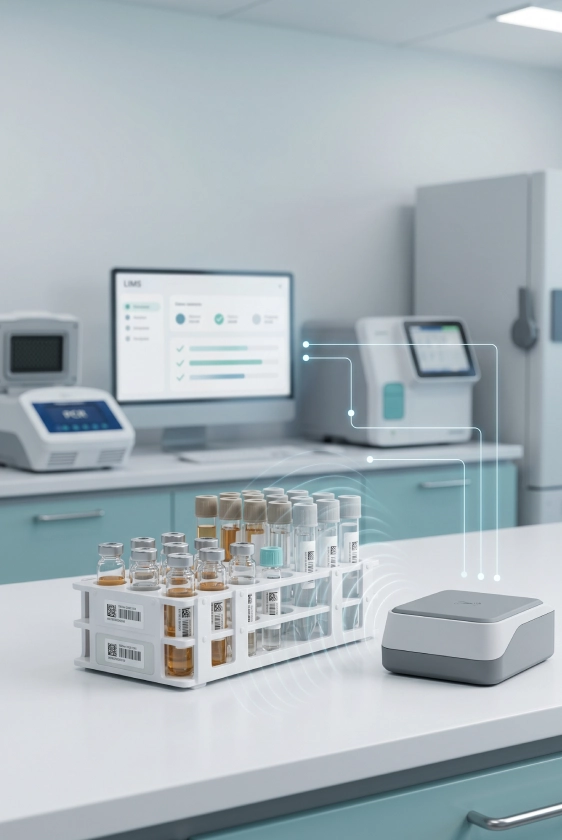
A laboratory RFID system has three parts: tags on the samples and assets, readers at the key checkpoints, and software that connects it all to your LIMS. Here is how a sample moves through it.
1
Each specimen, reagent, or asset is tagged at the point of collection or receipt and assigned a unique digital identity in the system.
2
RFID gates and tabletop readers are installed at sampling, storage, analysis, and disposal points. They register tags automatically, with no line of sight and no manual scanning.
3
As items pass each reader, location, vendor, and time-stamp are recorded. Multiple tags are captured in a single read.
4
The RFID system can be integrated into your LIMS, ERP or quality system, so records stay accurate without manual re-entry.
5
Temperature excursions trigger alerts, priority samples are flagged for staff, and a full audit trail is available on demand.
Benefits of RFID for Laboratories
Laboratories that move from barcodes and manual logs to RFID see measurable gains in accuracy, speed, and staff productivity.
✔
A continuous chain of custody removes the gaps where samples go missing or get mixed up.
✔
Automatic capture frees skilled staff from repetitive registration and lets them focus on analysis.
✔
Reading many tags at once and locating samples instantly speeds up the whole process.
✔
Every handover is recorded automatically, giving a transparent and traceable sample journey.
✔
Temperature and storage monitoring protects sensitive samples and flags issues before they cause loss.
✔
On-demand audit trails make accreditation and regulatory reporting much less of a manual exercise.
✔
Visibility of lot and expiry data helps use stock before it expires and cuts avoidable cost.
✔
Tags engineered for autoclave, chemical, and cryogenic exposure keep performing where labels fail.
Proven in Laboratory & Life Sciences
As a manufacturer we have delivered bespoke RFID systems for some of the most demanding laboratory and diagnostics equipment in the field. Here are four examples.
MOLECULAR DIAGNOSTICS
RFID in a digital PCR droplet machine
For a leading droplet digital PCR manufacturer, Eccel embedded eight custom RFID reader modules communicating over addressable RS485. High security tags carry encrypted, batch-specific data, so the machine monitors reagent levels automatically, alerts staff before stock runs low, and blocks counterfeit consumables.
LABORATORY ANALYSIS
Embedded RFID in HPLC analysis equipment
An HPLC manufacturer needed to guarantee that only genuine consumables are loaded across up to ten bays in a high-metalwork instrument. Eccel developed a reader/writer and a range of pre-printed, customer-encodable labels, all certified for FCC, ISED, and CE (RED), with reagents that can even be changed while the machine runs.
BIOMEDICAL, HIGH DENSITY
Multiplexed reader with up to 100 antennas
For a biomedical customer, Eccel designed multiplexed antenna readers scaling from 16 to 100 antennas in a tight grid, reading 6mm disc tags with strong isolation between neighbours to avoid false positives. All hardware and firmware was developed in-house for repeatable, tuning-free manufacture.
Why Choose Eccel
We are a manufacturer, not a reseller. That means you work directly with the engineers who design and build your tags and reader modules.
Built for harsh environments
On-metal, high-temperature, autoclave-tolerant, chemical-resistant, and IP67+ tags suited to real laboratory conditions.
Full frequency range
LF, HF and NFC, and UHF, so we can match the right technology to your read range, item size, and environment.
In-house design and manufacturing
A UK company that designs its own antennas and produces tags in our own European facilities, with direct access to our engineering team.
Custom design service
Bespoke labels for vials and small containers, custom enclosures, and pre-encoding to fit your workflow and systems.
Yes. We supply autoclave-tolerant tags engineered to withstand the high temperatures and pressure of sterilisation cycles, so an instrument or tray stays identifiable and traceable throughout its lifecycle. We can advise on the right tag for your specific cycle parameters.
Barcodes need a clear line of sight and are read one at a time at close range. RFID does not need line of sight, can be read from a distance, and registers many tags in a single pass. This removes manual scanning, speeds up handling, and reduces read errors from faulty scans.
It depends on the item and the environment. HF and NFC suit small items such as vials and individual samples where short, precise reads matter. UHF suits longer read ranges and bulk reading at gates and dock doors. We offer the full range and help you select the right one.
Yes. Our reader modules support standard interfaces such as RS485, SPI, I2C, and USB, which lets your integrator connect the RFID data into a LIMS, ERP, or quality system. As samples pass each reader, the relevant records update automatically.
For samples that require cold or sub-zero conditions, sensor-enabled RFID can track temperature alongside identity and location. If conditions move outside the required range, the system can alert staff promptly so the sample can be protected before it is compromised.
Yes. As a manufacturer we design bespoke antennas, labels, and enclosures, including small-format tags for vials, tubes, and slides, and we can pre-encode tags to suit your workflow. Contact our engineering team to discuss your requirements.
Ready to bring full traceability to your laboratory?
Talk to our engineers about the right RFID tags and reader modules for your samples, reagents, and equipment.
