


RFID Solutions for the Construction Industry
Construction sites are some of the most challenging environments in industry. Materials, plant, tools, and people move constantly across a dynamic site, lost equipment costs UK contractors millions every year, and around a third of working time is spent searching for or transporting materials rather than building.
RFID brings real-time visibility to the construction site. Tag your tools, plant, materials, and PPE, and you know what is where, when it arrived, who used it last, and whether it is on the right job. Eccel designs and manufactures the ruggedised tags and embedded reader modules that make site-level tracking work in conditions that destroy ordinary electronics.
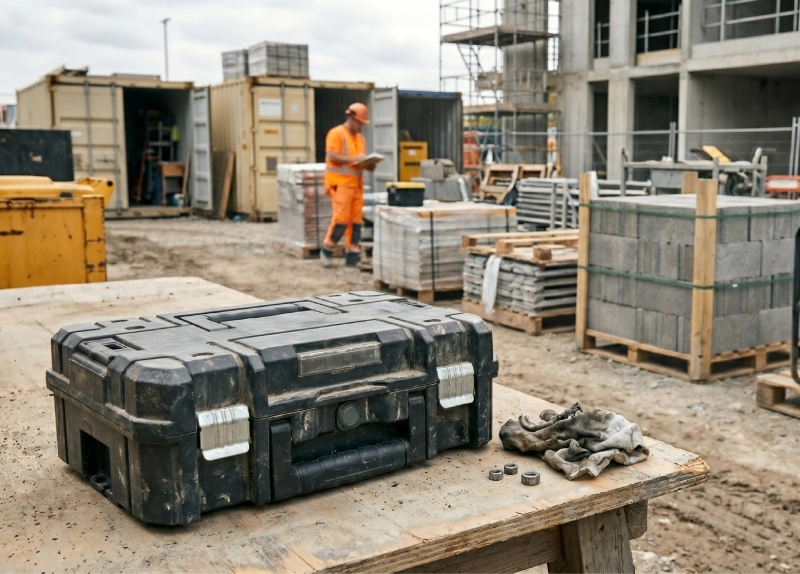
The Construction Site Challenge
Construction is one of the few major industries where manual tracking still dominates. The result is wasted time, lost assets, schedule slippage, and safety risks that better data could prevent.
+
Loss and theft of tools, small plant, and consumables drains contractor budgets every week. Without tracking, items move between sites unrecorded and reappear as unbudgeted replacements.
+
Around 33% of on-site working time is spent on logistics: searching for, moving, and verifying materials. Late, missing, or misidentified deliveries push schedules back and trigger expensive standing time.
+
Concrete dust, rain, impact, UV, and temperature extremes wreck barcodes and consumer-grade electronics within weeks. Asset tracking on a construction site demands hardware engineered for the environment.
+
CDM compliance and CSCS requirements mean knowing who is on site, who has the right competencies, and who has accessed restricted or hazardous zones. Manual sign-in books cannot deliver real-time accuracy.
RFID Applications in Construction
From tool cribs to tapping in at the gate, RFID supports every phase of construction logistics, asset management, and site control.
TOOLS & EQUIPMENT TRACKING
Tag drills, saws, levels, testing equipment, and high-value hand tools. Track which tools are on which site, who signed them out, and when service or calibration is due. Reduce loss, eliminate duplicate purchasing, and speed up tool issue from on-site stores.
MATERIAL & INVENTORY TRACKING
Tag pallets, bundles, and bulk materials at the supplier or at goods-in. RFID gates and handheld readers verify deliveries against orders, track materials to lay-down areas, and trigger alerts when stock reaches reorder thresholds. Cut search time and reduce wastage.
PLANT & HEAVY MACHINERY
Tag excavators, dumpers, telehandlers, generators, and welfare units. RFID gate reads capture every movement between yards, depots, and sites. Support fuel reconciliation, scheduled maintenance, hire return tracking, and theft recovery across the fleet.
YARD & COMPOUND MANAGEMENT
RFID portals at site gates read deliveries, plant movements, and skip collections automatically. Match arrivals to expected manifests, log departures with timestamps, and produce accurate yard inventory without manual checks or paperwork.
WORKER ACCESS & SAFETY ZONES
RFID-enabled CSCS-style cards or helmets verify operative competency, induction status, and authorisation at site entry and restricted zones. Block unauthorised access to hazardous areas, maintain accurate fire registers, and generate full audit trails for CDM compliance..
PRECAST & PREFABRICATED COMPONENTS
Tag precast concrete panels, modular units, and prefabricated assemblies during manufacture. Track every component from factory through transport, on-site storage, and crane lift to final installation. Verify the right part lands in the right place at the right time.
CONCRETE MATURITY MONITORING
Embed RFID sensor tags into freshly poured concrete to monitor temperature and maturity during curing. Make data-driven decisions about formwork strike timing, accelerating programme without compromising strength. Replace destructive cube testing with continuous measurement.
SITE INVENTORY AUDITS
Replace manual stock-takes in site stores, container offices, and lay-down yards with handheld RFID audits. Walk a compound and capture every tagged item in minutes. Reconcile against purchase records to identify shrinkage, duplicates, or misallocation across projects.
BIM & DIGITAL TWIN INTEGRATION
Link RFID-tagged components and assets directly into your BIM model. Capture as-built data automatically, populate digital twins with real installation records, and hand over a complete asset register to facilities management at practical completion. Supports GS1 standards for full interoperability.
How RFID Works on a Construction Site
A construction site RFID system combines ruggedised tags, fixed gate readers, handheld scanners, and worker-issued credentials, feeding data into your existing site management software.

1
Apply ruggedised RFID tags to tools, plant items, material pallets, and prefabricated components. Issue RFID-enabled cards or helmet tags to operatives, linked to CSCS records, inductions, and competencies.
2
RFID portals at site entrances, store containers, and restricted zone access points read tags automatically as people and assets pass through. No manual scanning, no line-of-sight required.
3
Site managers and quantity surveyors use handheld RFID readers to verify deliveries, audit lay-down areas, locate specific components, and run rapid stock-takes across containers and compounds.
4
Data can be integrated into your site systems, ERP, project management platform, or BIM environment. Standard data formats and GS1 EPC coding support interoperability across suppliers and contractors.
5
The system generates daily site reports, flags missing or unauthorised movement, captures real-time progress data, and produces complete as-built asset records for handover and facilities management.
Benefits of RFID in Construction
Contractors and subcontractors adopting RFID see measurable returns across loss reduction, programme efficiency, safety, and handover quality.
✔
Real-time tracking of every tagged item makes loss visible the moment it happens. Contractors deploying RFID for tools and plant typically report 50% or greater reductions in unaccounted-for items within the first year.
✔
Accurate stock data prevents over-ordering, identifies misallocation between sites, and reduces the spoilage that comes from materials being lost in lay-down areas. Direct contribution to sustainability and cost targets.
✔
Automated delivery verification, faster picking, and reduced search time recover a meaningful share of the 33% of working time typically spent on materials handling. The recovered hours flow straight into productive work on the build.
✔
Improved Concrete Programme
Embedded maturity sensors enable data-driven decisions on formwork strike, slip-form progression, and post-tensioning. Cycle times reduce while structural quality is verified continuously, not by destructive testing.
✔
Real-time visibility of materials, plant, and prefabricated components means schedule risks are spotted early. Critical-path delays caused by missing or misidentified items are reduced or eliminated.
✔
RFID-tagged assets and components produce a clean, machine-readable as-built register at handover. Facilities management teams inherit accurate data from day one rather than rebuilding it from paper drawings.
✔
Automated access control, induction verification, and zone-level operative tracking strengthen CDM compliance and improve emergency response. Audit trails are generated automatically for every site movement.
✔
RFID data populates BIM models with real construction events, not just design intent. Digital twins become operationally accurate, supporting predictive maintenance and lifecycle management of the completed asset.
Why Choose Eccel for Construction RFID
Adding embedded RFID to construction equipment demands specific engineering expertise. We manufacture our reader modules at our own facility in Poland, while our team focuses on our core USP: adding RFID/NFC capabilities to your products easily, quickly, and cost-effectively. Our skill is rapid design turnaround-ensuring your system works 100% in harsh site environments with all the necessary regulatory approvals already in place
Ruggedised Tags
On-metal tags for plant and steelwork, high-temperature tags for concrete curing, IP67-rated enclosures for outdoor exposure, and adhesion solutions for rough surfaces like concrete and timber.
UHF for Site Range
UHF (860 to 960 MHz) delivers the read range construction needs: up to 15 metres for gate reads, crane-mounted readers, and yard portals. The right frequency for materials, plant, and outdoor assets.
PL Manufacturing
Design and production under ISO 9001. Short lead times, transparent supply chain, and direct engineering access for system integrators and construction technology partners.
OEM-Ready Reader Modules
Pre-certified reader modules (FCC, CE) with RS485, SPI, I2C, USB, Wi-Fi, Ethernet, and WPAN interfaces. Built to embed into gate hardware, kiosks, tool cribs, and custom site equipment for system integrators.
Need ruggedised RFID hardware for a construction project?
Contact our team for a consultation. We supply system integrators, construction technology partners, and contractors building site-specific RFID solutions.
