


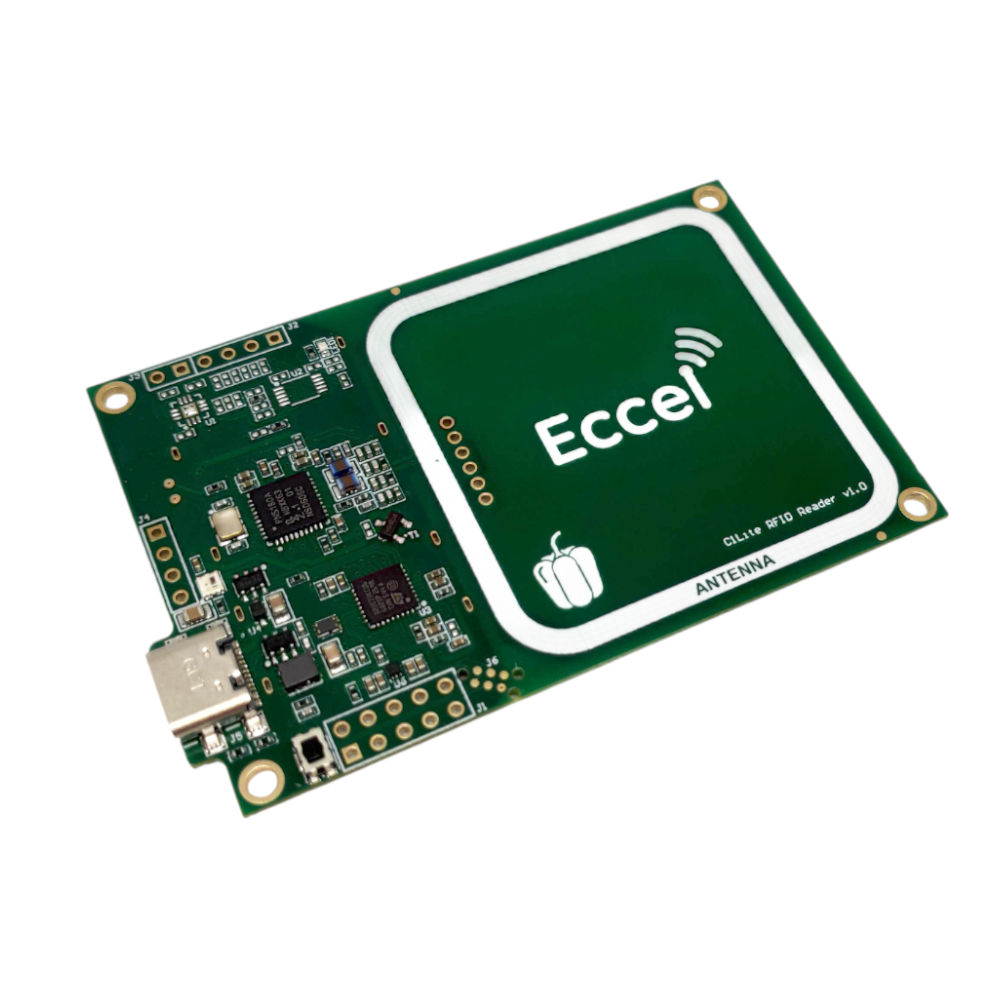
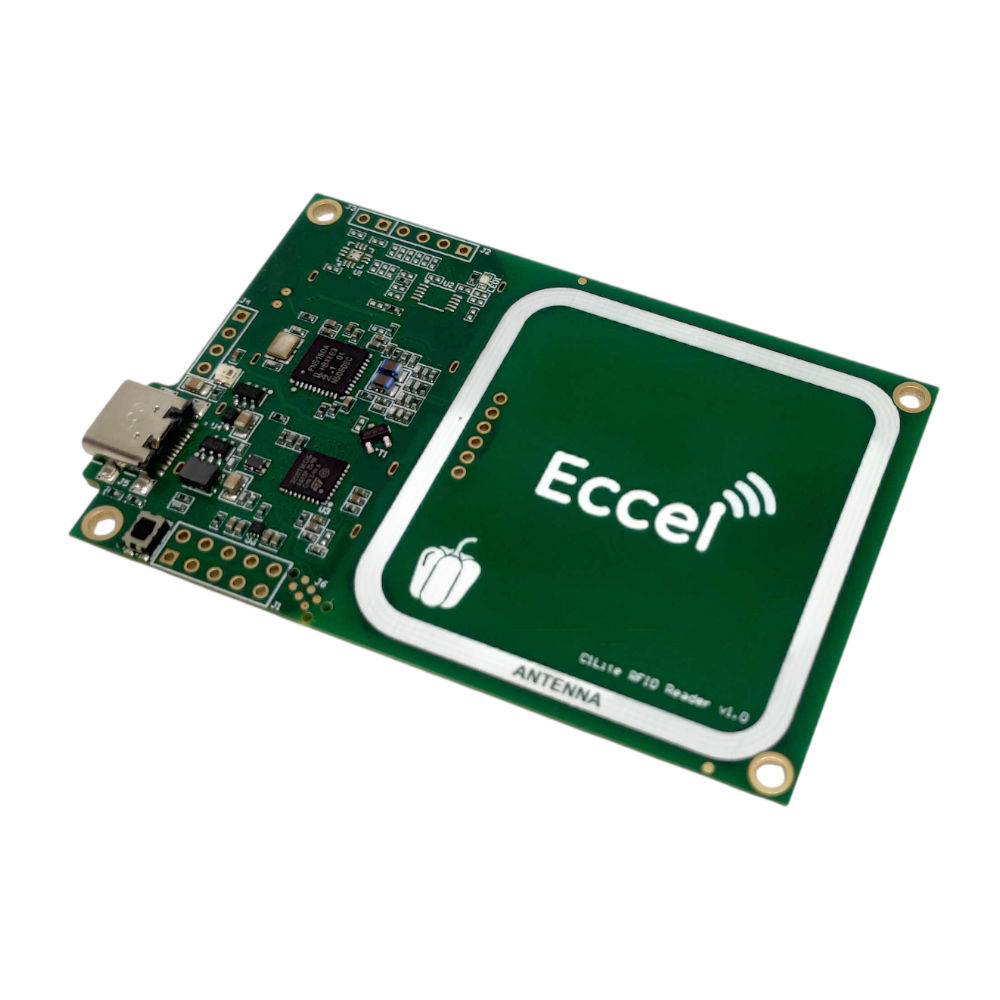
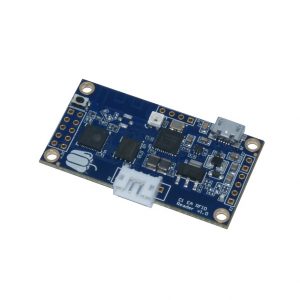
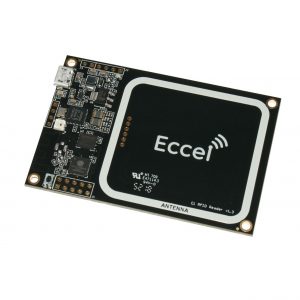
The Pepper C1 Lite RFID Reader brings the proven RFID functionality of the Pepper C1 platform to applications that do not require wireless connectivity. Built around an STM32 microcontroller and a high-performance RFID frontend, it contains no Wi-Fi or 2.4 GHz WPAN functionality and communicates with the host through wired interfaces.
This architecture makes Pepper C1 Lite a strong choice for organisations that standardise on STM32, restrict wireless-capable processors or require tighter control over the available communication paths. Removing wireless functions also simplifies deployment in systems where Wi-Fi, BR/EDR + LE, MQTT, REST API, WebSockets and TCP/IP are unnecessary.
Pepper C1 Lite operates at 13.56 MHz and supports ISO/IEC 14443A and ISO/IEC 15693 technologies, including MIFARE Classic® 1K and 4K, MIFARE Ultralight®, NTAG®, MIFARE DESFire® EV1/EV2, MIFARE Plus® and ICODE®. Its comprehensive command set provides access to identification, memory and security-related functions supported by the individual transponder families.
The reader can operate under host control or independently in standalone polling mode. Configurable polling allows the device to detect tags continuously, distinguish between known and unknown UIDs, read selected memory areas and trigger different actions. Known tag identifiers and keys can be stored in the reader’s internal memory.
Automatic responses can include binary, plain-text or JSON packets, RGB LED indications and GPIO state changes. Six configurable GPIOs make it easy to control or monitor external equipment such as locks, relays, indicators and sensors without adding complex host-side logic.
The USB interface can operate as a virtual serial connection or emulate a USB HID keyboard. In HID mode, tag UIDs are entered into the connected computer or terminal as keyboard input, allowing straightforward integration with existing software, forms and access-control applications without a dedicated driver-level protocol implementation.
Pepper C1 Lite is available with USB/UART, RS232 and RS485 connectivity. The RS485 version supports full-duplex operation and can also be configured for half-duplex wiring, making the reader suitable for industrial installations and longer wired communication links. UART speed is configurable up to 921600 bps.
Configuration and testing are handled by the free Cx-Client for Windows. The application provides access to RFID polling parameters, stored keys, known UID lists, USB and UART configuration, and the complete binary command interface. Firmware updates remain available through the wired communication interface.
Key features:
Hardware features:
- 13.56 MHz RFID/NFC reader and writer
- STM32 microcontroller and high-performance RFID frontend
- No wireless functionality
- Six configurable GPIOs for external devices
- Configurable RGB LED indicator
- Built-in function button
- Multiple internal reference voltages
Wired interfaces:
- USB/UART, RS232 and RS485 product options
- USB virtual serial interface
- USB HID keyboard emulation
- UART baud rate configurable up to 921600 bps
- RS485 full-duplex and half-duplex wiring support
Software and integration features:
- Host-controlled operation
- Standalone polling mode
- Configurable polling interval and RFID output level
- Separate actions for known and unknown tags
- Selected tag-memory reading during polling
- Configurable known UID list stored in the reader
- Internal key storage
- Binary, plain-text and JSON polling output
- Configurable GPIO and RGB LED actions for RFID events
- Cx-Client software for Windows
- Documented binary communication protocol
- Lifetime firmware update support through a wired interface
Supported standards and transponders:
- ISO/IEC 14443A
- ISO/IEC 15693
- MIFARE Classic® 1K and 4K
- MIFARE Classic® Mini
- MIFARE Ultralight® and MIFARE Ultralight C®
- NTAG®
- MIFARE DESFire® EV1/EV2
- MIFARE Plus®
- ICODE®, including supported ICODE SLI, SLIX and DNA families
Operating conditions and compliance:
- Operating temperature from -25°C to +85°C
- Supply voltage from 3 V to 5.5 V through USB or the power header
- RoHS compliant
- CE (RED) compliant
Typical applications:
- Access-control systems
- Consumable identification and approval
- Goods and asset monitoring
- Pre-payment systems
- Resource management
- Contactless data storage
- Industrial automation
- RFID system evaluation and development
- Installations that prohibit Wi-Fi or WPAN (BR/EDR + LE) hardware
Pepper C1 Lite vs Pepper C1
Pepper C1 Lite retains the Pepper C1 family’s RFID/NFC tag support, read/write commands, standalone polling, known UID list, key storage, RGB LED control and GPIO integration. The main distinction is connectivity and processor architecture.
Pepper C1 Lite uses an STM32 microcontroller with a high-performance RFID frontend and offers wired USB/UART, RS232 and RS485 communication plus USB HID keyboard emulation. It does not include Wi-Fi, WPAN (BE/EDR + LE), a Web Interface or network/IoT services.
The original Pepper C1 uses a wireless-enabled MCU with a high-performance RFID frontend and is the better option when Wi-Fi, WPAN (BR/EDR + LE), TCP client/server, MQTT, REST API, WebSockets, browser-based configuration or wireless Over-the-Air updates are required.




Reviews
There are no reviews yet.