

Anti-Cloning RFID & Encrypted Access Credentials
Most access control still runs on credentials that can be copied. A legacy 125 kHz card broadcasts an unencrypted number that a reader bought online for the price of a takeaway can capture and duplicate onto a blank card in a few seconds, with no technical skill required. Even early smart cards can be cracked. Once a credential is cloned, an intruder walks in as someone else, and your access log no longer tells the truth.
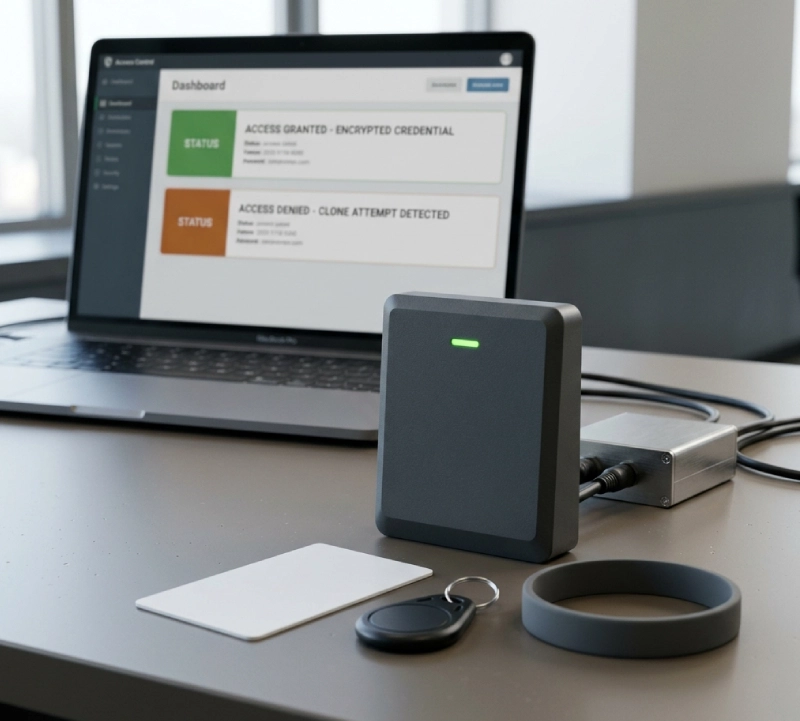
Eccel builds the answer at three levels rather than one. We supply encrypted credentials that resist duplication, reader modules that run our own anti-cloning protocols, and cloud verification that catches cloned cards while a system is live. We are the embedded RFID engine that OEMs and integrators build into their own secure access products, not a box of cards off the shelf.
Why Credentials Get Cloned
Cloning is cheap, fast, and widespread, but only against the wrong technology. These are the weaknesses that make it possible.
Unencrypted legacy cards
125kHz – 150kHz proximity cards send a plain, unencrypted serial number. Anyone who reads it can copy it exactly, because there is no secret to protect it.
The tools are cheap and simple
Card copiers cost as little as the price of a meal and need no skill. A working duplicate can be made in seconds.
Older smart cards can be broken
Early MIFARE Classic added authentication, but its weaknesses are well known, default keys are often left unchanged, and smartphone apps can clone it.
A card can be read without being seen
A reader held close in a lift or a crowd, or one that eavesdrops on a genuine read, can capture a credential straight from a pocket or lanyard.
Technology
Feature
Barcode
Notes
125kHz – 150kHz proximity
None
Low
Broadcasts an unencrypted serial number. Copied with cheap tools in seconds.
MIFARE Classic (13.56 MHz)
Legacy
Medium
Has authentication, but known weaknesses and unchanged default keys leave it exposed.
MIFARE DESFire EV2 (13.56 MHz)
AES-128
High
Mutual authentication and diversified keys. Not clonable with off-the-shelf devices.
Eccel encrypted & cloud-verified
AES-128 plus Eccel protocols
Very high
Encrypted credentials and reader-side protocols, with cloud verification that catches and blacklists clones in operation.
No technology can promise absolute security, but encrypted, mutually authenticated credentials cannot be copied with the consumer tools used to clone legacy cards.
Eccel’s Three Layers of Defence
Most suppliers stop at the card. We offer three layers of defence-protecting the credential, the reader, and the live system. These layers are modular: you can deploy just one, combine two, or use all three together. This ensures a clone is resisted at the door and caught if it ever gets made.
1
Encrypted credentials
When credentials cannot be faked, your access log records who really went where and when.
2
Anti-cloning protocols on the reader
Our reader modules run Eccel’s own anti-cloning protocols with 128-bit encryption, adding a layer of protection on top of the chip rather than relying on the credential alone.
3
Cloud verification in operation
Readers can check each credential against a central cloud database in real time. If a duplicate appears, the system detects it, blacklists it automatically, and traces the misuse, even for cards that were cloned before the check existed.
What This Gives You
The reasons OEMs and integrators build Eccel’s secure credentials and readers into their access products.
CREDENTIALS THAT RESIST COPYING
Encrypted, mutually authenticated cards, fobs, and wristbands that cannot be duplicated with consumer cloning tools.
PROTECTION BEYOND THE CHIP
Our own reader-side protocols mean security does not rest on the credential alone.
CLONES CAUGHT IN OPERATION
Cloud verification detects and blacklists duplicated cards while the system is live.
A TRUSTWORTHY AUDIT TRAIL
When credentials cannot be faked, your access log records who really went where and when.
INSTANT ISSUE AND REVOKE
Lost or suspect credentials are disabled centrally in seconds, with no need to change locks.
BUILT FOR INTEGRATION
Reader modules with standard interfaces and free libraries drop into your own controller and product.
Proven Against Cloning
Two projects where Eccel solved the exact problem this page describes, using our own encryption and cloud verification.
HOUSING
Encrypted Fobs for Shared Housing
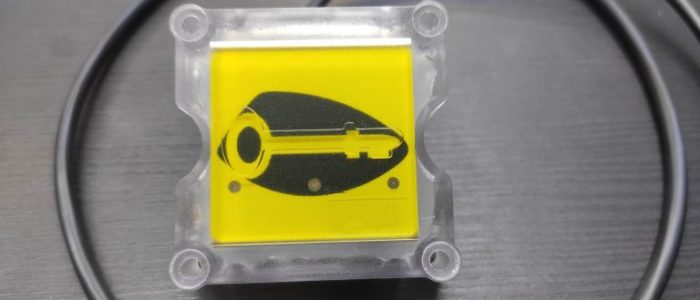
For UK apartments, social housing, and short-let properties, Eccel designed and manufactured an encrypted key fob and door entry reader using its own anti-cloning protocols with 128-bit encryption. The system links to a managed cloud database for real-time oversight, deactivates lost fobs instantly, and is available in a vandal-resistant housing.

WATER DISTRIBUTION
Cloud-Verified Anti-Cloning Reader
A water network was losing revenue to cloned cards that unlocked free water. Replacing every user card was not viable, so Eccel built a reader with a GSM module that checks each card’s stored credit against a central cloud database. Cloned cards fail the second check, are blacklisted automatically, and the misuse is traced, all without replacing the existing dispensing equipment.
Where Anti-Cloning Matters
Clone-resistant credentials protect any site where a copied card is a real risk. These are the sectors where we apply them.
Frequently Asked Questions
Common questions about card cloning and how to prevent it.
Not with the tools used to copy legacy cards. DESFire uses AES-128 and mutual authentication, so the card and reader verify each other and the data is never sent in the clear. No credential is absolutely uncrackable, but these cannot be duplicated with consumer cloning devices.
Yes. 125 kHz proximity cards transmit an unencrypted serial number that can be copied with cheap, widely available tools. Any site where security matters should move to encrypted credentials.
It means the card and the reader each prove they are genuine before any sensitive data is exchanged. An attacker’s reader cannot trick the card into transmitting, and a fake card cannot satisfy a genuine reader.
Yes. This is where cloud verification comes in. Readers check each credential against a central database in real time, so a duplicate is detected, blacklisted automatically, and traced, even if the original card was cloned before the check was in place. We built exactly this for a national water network.
Not necessarily. Where replacing all credentials is not practical, a verification layer can protect an existing deployment while you migrate. Our water network project secured cloned cards without replacing the user cards or the dispensing equipment.
Both. We supply encrypted credentials, reader modules that run our own anti-cloning protocols, and the design support to build them into your product, including custom credentials, antennas, and cloud verification.
Building an access product that has to resist cloning?
Talk to our engineers about encrypted credentials, anti-cloning reader modules, and cloud verification for your access application.
