

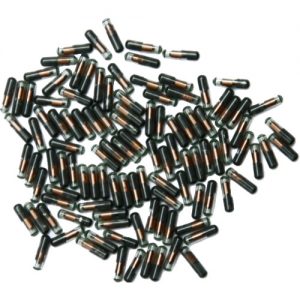
 Injectable Transponder Animal Tags EM4102. 12mm x 2mm 125KHz
 Avian Products
-
Injectable Transponder Animal Tags EM4102. 12mm x 2mm 125KHz
£2.95Add to basketEM4102 injectable glass tag 12mm long and 2mm diameter. For use with our EM4102 dataloggers in conjunction with loop antennas up to 80mm diameter.
The country of origin for this product is China. If these are being shipped into the United States, please note there may be US federal government tariffs applicable.
The HS code for this product is 8534.00.9000.
1. What is the expected battery life of the device?
The minimum operating time under maximum load (utilizing two antennas, a 100ms polling interval, and "Night Mode" disabled) is 4 days.
However, this duration can be extended to several weeks by optimizing the settings based on the activity patterns of the monitored animals - specifically by enabling the Night Mode feature.
2. How many animals or birds can be detected simultaneously?
The implemented technology is designed to detect only one tag at a time. If multiple tagged animals are within the antenna's range simultaneously, the reader will be unable to identify any of them. This limitation should be taken into account when designing the nesting box and its entrance; physical dimensions should be optimized to minimize the likelihood of more than one bird occupying the detection zone at once.
3. How do I correctly retrieve recorded data from the device?
Before disconnecting the Logger, it is essential to power the device on using the physical button. This step ensures that data accumulated on the RFID module is properly synchronized/transferred, preventing any potential data loss. Once the device is active, connect to its Wi-Fi network and download the log files using a standard web browser.
4. What is the proper procedure for charging the device?
For optimal charging speed, we recommend using a USB-C cable and a power adapter with a nominal current of 2.4A.
While the device can be charged from any standard USB port (including those on computers or laptops), please be aware that the charging process will take significantly longer.
5. How can I check the battery level?
The most accurate way to monitor the battery status is via the web browser interface after activating the Logger. Please note that the integrated fuel gauge requires several full charge and discharge cycles to calibrate. This "learning process" is necessary for the device to provide precise percentage readings.
6. What is the effective reading range of the device?
The detection range depends primarily on the size of the RFID tag, which corresponds to the dimensions of its internal coil. Generally, a larger tag coil results in a greater reading distance. When using the smallest tag provided by Eccel, the range should be at least 3 cm.
7. How can I optimize the reading range?
To achieve optimal performance, ensure that there are no metallic objects in the vicinity of the antenna coil. The presence of other electrical wires can also interfere with the electromagnetic field, leading to a reduced range.
Additionally, when installing the antenna cable, ensure it is routed straight and avoid creating loops, as these can further degrade signal quality.

